From volatile wholesale prices and rising non-commodity charges to the importance of renewal timing, discover what your business should consider when planning its energy costs for 2027 and beyond.
With energy costs continuing to put pressure on business budgets, knowing when and how to buy energy is becoming increasingly important. But with volatile wholesale prices, rising non-commodity charges and different purchasing options available, making the right decision isn’t always straightforward.
In our recent webinar, Your Energy Buying Options for 2027 & Beyond, Sean Dixon, Chief Revenue Officer at Fidelity Energy, explored the factors shaping business energy costs and the decisions businesses should be considering as they plan ahead.
We’ve brought together eight key takeaways from the session to help you understand the market, avoid costly purchasing decisions and take greater control of your energy costs in 2027 and beyond. From the risks of leaving renewals too late to choosing between fixed and flexible contracts, here’s what every business should know.
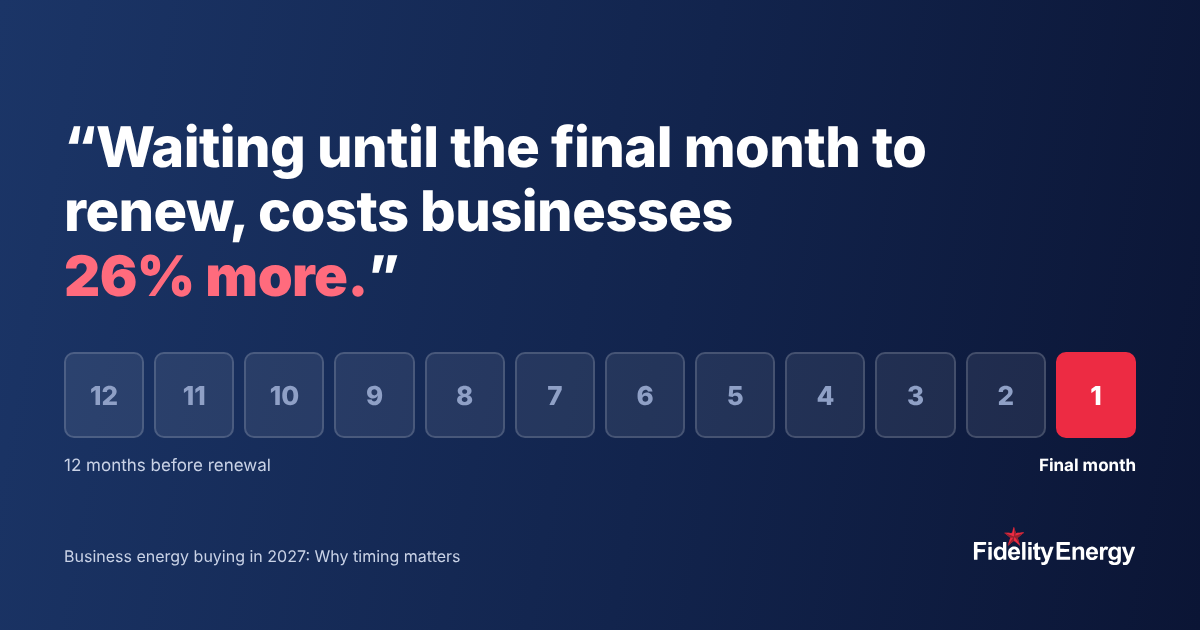
Businesses renewing in the final month faced wholesale energy prices 26% higher than those available six months earlier in our 2026 analysis. Planning ahead gives you more time to assess your options and make informed purchasing decisions.

Wholesale gas prices rose by around 175% between February and October 2026, from 77p to 212p a therm. Market volatility can significantly affect what your business pays, making it important to stay informed, even when renewal is some way off.
Our analysis found that purchasing nine months before renewal delivered the greatest average saving across 2024–2026. However, six months ahead provided a more consistent outcome. The key is understanding market conditions rather than relying on a fixed renewal date.
Fixing nine months out saved the most on average
Average saving compared with fixing in the final month, 2024 to 2026. Green is cheaper, red is dearer. The smaller figure under each bar is the extra cost in the worst single year.
Source: Fidelity Energy webinar slides, November 2026. Electricity, 250,000 kWh a year, October start.
In a falling market, locking in rates too far ahead can mean missing out on lower prices. Planning early is important, but knowing when to act is what really matters.
Around 65% of a typical business electricity bill in our analysis comprised non-commodity costs, including network charges and government levies. Understanding your full bill helps you identify where costs are coming from and where savings may be possible.
Non-commodity electricity costs have roughly doubled over the past four years. Even when wholesale prices fall, these additional charges can keep overall bills high. Managing consumption and checking billing accuracy are becoming increasingly important.
Non-commodity costs have roughly doubled in four years
£ per MWh for a typical half-hourly business site. Each year runs April to March, the period network charges are set for.
Source: Fidelity Energy webinar slides, November 2026. Indicative averages.
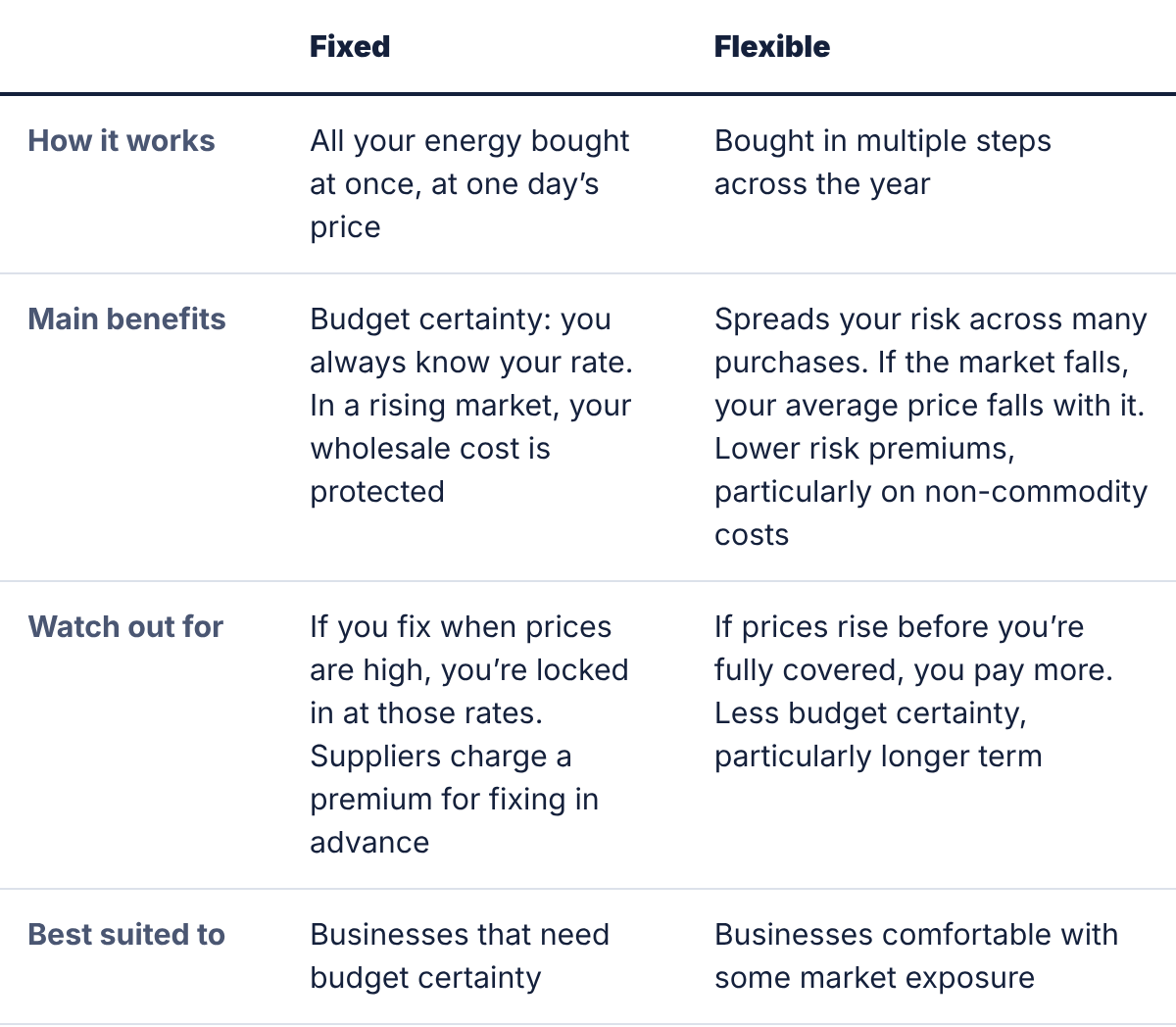
Fixed contracts offer greater budget certainty, while flexible purchasing spreads buying decisions over time. The right approach depends on your energy usage, financial priorities and appetite for risk.
“Nobody chose that price. The calendar did.”
Understanding your contract dates, consumption, costs and purchasing options puts you in control. Whether your renewal is three months or three years away, staying informed means you can make decisions based on what’s right for your business, rather than what the calendar dictates.
Whether your energy contract is approaching renewal or you’re planning further ahead, understanding your options now could make a real difference to your future costs.
At Fidelity Energy, we help our partners and customers navigate changing energy markets, identify opportunities to save and choose purchasing strategies that balance cost, certainty and risk.
Let’s make sure your next energy procurement decision is the right one.

Sean Dixon
Chief Revenue Officer, Fidelity Energy
Our webinar, Your Energy Buying Options for 2027 & Beyond, explored these insights in more detail, including real-world purchasing scenarios and the differences between fixed and flexible energy strategies.
The full recording and presentation are available exclusively to Fidelity Energy customers and partners.
Already working with us? Contact your Fidelity Energy account manager or channel partner to request access.
Figures come from Fidelity Energy’s webinar, Your Energy Buying Options for 2027 & Beyond (November 2026). The 26% figure is based on Fidelity Energy renewals signed in the final six months of a contract in 2026, compared with the wholesale price six months before renewal. Timing examples are for an electricity contract of 250,000 kWh a year starting in October, compared with fixing in the final month. Non-commodity costs are indicative averages for a half-hourly business site and vary by region, voltage and band.